A Brief Look Into Epigenetics' History
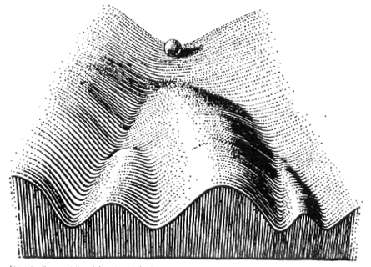
Conrad Hal (C.H.) Waddington, an embroyologist and geneticist from the 1930's to 1950's, is famous for his concepts of "epigenetic landscape"(1) founded in 1957. His concept claimed that cells' "fates" were established during its developments. He defined epigenetics as "the branch of biology which studies the casual interactios between genes and their products, which brings the phenotype into being" (1). |
This painting by John Piper shows Waddington's concept for epigenetic landscape (1). The cell, represented as a ball in this picture, shows all the paths possible in the ball's direction and that once the path is chosen, it cannot be reversed along with the effects it has on the ball. |
In the 1980s, Dr. Lars Olov Bygren started his research on the long term effects the hard years of Norbotten, Sweden had on the people living there during the 18th century. At the time, Norbotten was dealing with crop failure and a land spill, affecting the amount of food the small population living there received. Dr. Lars Olov Bygren took 99 random individuals living in the Overkalix part of Norbotten and compared their health to how much food their parents and grandparents ate, based on agriculutral records.
Dr. Lars Olov Bygren's foundings came to the conclusions that the grandkids of Overkalix boys who over ate during the time of crop failure died on average 6 years earlier than the grandsons of the Overkalix boys who barely ate. With this information, he had found a way to prove the possibility that epigenetic hereditary does take place in humans (16).
|
Dr. Lars Olov Bygren, his son, and grandson. |
Histone Modification is the binding of epigenetic factors to histone tails that can alter the extent to which DNA is wrapped around the histones and the availability of genes that can be activated. |
DNA Methylation is the addition of a methyl group to a DNA nucleotide. This addition can either activate or repress genes. DNA Methylation is present in regulating many cellular processes, such as when somatic cells divide, in X-chromosome inactivation, genomic imprinting and the chromatin structure/remodeling and gene transcription. It does not affect the genetic code, but instead the epigenetic code. (10) |
Factors That Affect Epigenetic Mechanisms
Development
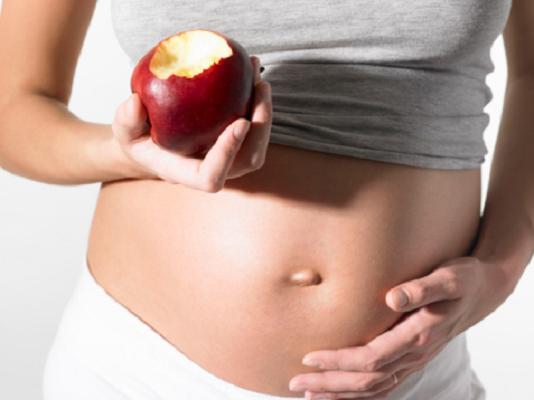
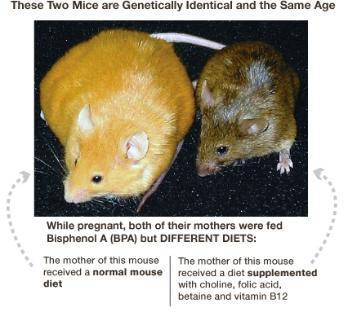
Your mother's diet during pregnancy and what you're fed as an infant can cause changes that stick with you into adulthood. Animal studies have shown that defiency of methyl-donating folate or choline during late fetal or early postnatal development causes certain regions of the genome to be under methylated for life. For adults, a methyl deficient diet still leads to a decrease in DNA methylation, but the changes can be reversed by consuming a normal diet. (5) |
Exposure to Enviromental Chemicals/Drugs/Pharmaceuticals:
Chemicals and additive that enter our bodies can also affect the epigenome. Bisphenol A (BPA) is a compound used to make polycarbonate plastic. It is used in many consumer products including water bottles and tin cans. When pregnant yellow aguoti mothers were fed BPA, more yelow, unhealthy babies were born than normal. Exposure to BPA during early development had caused decreased methylation of the agouti gene. (5)
Ageing
As we age, our stem cells divide more and more to replenish tissue damage. The cells in the tissues' life span is only for a couple of weeks, maybe months, then they need to be replenished again. If they divide more than a given number of times, these epigenetic patterns will show subtle shifts that increase with age. (5)
|
Diet
Nutrients from our food are turned into methyl groups along a pathway: the pathway is made up of many players that manipulate molecules into methyl groups and ultimately put them on our DNA. (5)
To prove that diet does affect epigenetic mechanisms, alot of labs are done on mice because humans are genetically different, have even more different epigenomes making it hard to not only regulate what they eat but if the effects are the same from person to person. |
|
Nutrient |
Food Origin |
Epigenetic Role |
|
Methionine |
Sesame seeds, brazil nuts, fish, peppers, spinach |
SAM synthesis |
|
Folic Acid |
Leafy vegetables, sunflower seeds, baker's yeast, liver |
Methionine synthesis |
|
Vitamin B12 |
Meat, liver, shellfish, milk |
Methionine synthesis |
|
Vitamin B6 |
Meats, whole grain products, vegetables, nuts |
Methionine synthesis |
|
SAM-e (SAM) |
Popular dietary supplement pill; unstable in food |
Enzymes transfer methyl groups from SAM directly to the DNA |
|
Choline |
Egg yolks, liver, soy, cooked beef, chicken, veal and turkey |
Methyl donor to SAM |
|
Betaine |
Wheat, spinach, shellfish, and sugar beets |
Break down the toxic byproducts of SAM synthesis |
|
Resveratrol |
Red wine |
Removes acetyl groups from histones, improving health (shown in lab mice) |
|
Genistein |
Soy, soy products |
Increased methylation, cancer prevention, unknown mechanism |
|
Sulforaphane |
Broccoli |
Increased histone acetylation turning on anti-cancer genes |
|
Butyrate |
A compound produced in the intestine when dietary fiber is fermented |
Increased histone acetylation turning on 'protective' genes, increased lifespan (shown in the lab in flies) |
|
Diallyl sulphide (DADS) |
Garlic |
Increased histone acetylation turning on anti-cancer genes |
Chart on nutrients that affect our epigenome and where they come from. (5) |
The Epigenetic Tags' Memory
Epigenetic tags act as a kind of cellular memory. A cell's epigenetic profile - a collection of tags that tell genes whether to be on or off - is the sum of the signals it has received during its lifetime (11). It acts as a reminder to the cell, reminding the cell's genes what it is it should be doing.
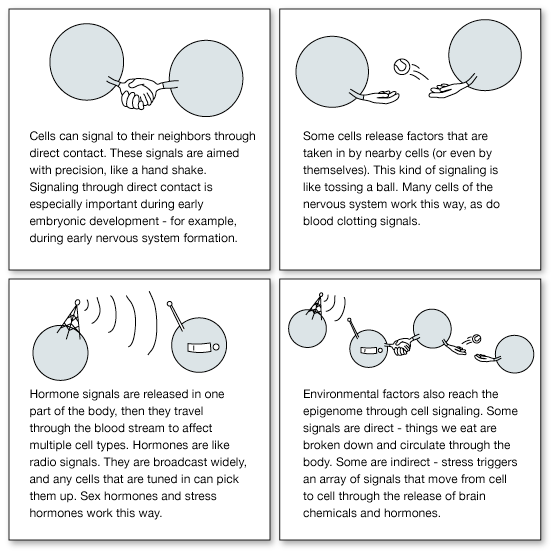
The epigenome changes in response to signals. This chart below shows different types of signals that can get through to the epigenome. |
Gene Regulatory Proteins That Carry the Signals to the DNA Can Do One of Two Things:
1. Switch specific genes "on" or "off": Gene regulatory proteins attaches to a specific sequence of DNA on one or more genes. After doing so, it has the ability to turn on or switch off genes.
Or 2. Recruit enzymes that add and remove epigenetic tags: Gene Regulatory Proteins gather together enzymes that can add epigenetic tags to the DNA, histones, both or remove them. (3) |
|