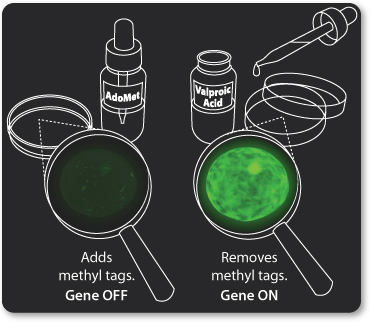
Research is being conducted on a variety of drug therapies that can change the epigenetic profile of cancer cells. However, epigenetic therapies can be a challenge due to the need to figuring out how to not only get the target drug to the correct genes but in the right tissues.
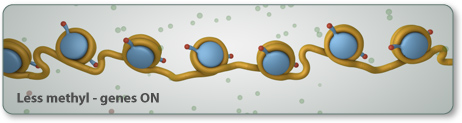
Cancer cells that have less methylation than healthy cells do, which leads to more active DNA. Less methylation than needed can lead to loss of imprinting, the active DNA being duplicated, deleted, or moved, and the activation of genes that promote cell growth.
|
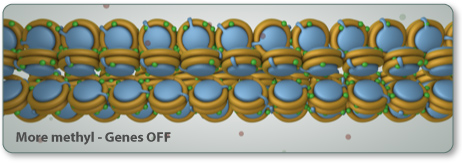
Cancer cells that have more methyl than healthy cells have less active DNA. The genes that repair DNA, regulate cell growth and start the programmed death of a cell are turned off in cancer cells.
|
This video shows how twins help prove that epigenetic factors do change and work in humans the way they do in mice. It also shows small excerpt on how epigenetic therapy works and what its so far capable of doing for its patients.
An Interview On Dr. Jean-Pierre and His Study on Epigenetic Therapy And Its Impact; Done By PBS's Nova
You've studied one kind of cancer, MDS, that appears to be caused by epigenetics. Can you tell me in the simplest terms, what is MDS?
If you look at the bone marrow of a patient with MDS, Myelodysplastic Syndrome, what you will see is 99% cancer cells. Those cancer cells are doing what cancers do, which is copy themselves tirelessly. And they continue to crowd out the tissue and prevent the normal function of that particular tissue. Bone marrow makes blood cells: the cells that carry oxygen, the red blood cells; the cells that fight infections, the white blood cells; and the cells that prevent bleeding with platelets. All of these cells become abnormal in patients with MDS, who typically have very low levels of these cells
Patients, unfortunately, die of this disease. They die of bleeding. They die of severe anemia and heart attacks, for example. Or some patients die of overwhelming infections because they are unable to mount an immune response to these infections (17)
What made you think this cancer was epigenetic in origin?
MDS, perhaps more so than many other cancers, is a disease of older people with a median age of 70. Older individuals have prominent epigenetic changes compared to newborns or even young individuals. Therefore, any disease of the old is likely to have an epigenetic component.
But even cancers in young people can have epigenetic changes. So MDS is, in this respect, not all that different from other cancers. What is different is that MDS is a disease where these drugs that affect epigenetics were found to be particulary effective (17)
Compared to standard chemotherapy, what are the side effects of epigenetic therapy?
The standard way of developing drugs in oncology is to take a drug and give it at the highest possible dose that will not kill the patient. The key really has been the realization that you don't need to do that for epigenetic-acting drugs. All you need is to give enough of it to change the epigenetic patterns in the cancer cells to have a therapeutic effect. Therefore, we have backed down substantially from the very toxic doses of these drugs to doses that right now, we are very happy to say, have very minimal side effects (17) |
So when you say epigenetic therapy, you're not going in and trying to kill the cancer cells. What are you trying to do?
The idea of epigenetic therapy is to stay away from killing the cell. Rather, what we are trying to do is diplomacy, to change the instructions of the cancer cells. You see, cancer cell start out as normal cells. They have the set of instructions that is present in every one of our cells.
In the process of becoming cancer, a lot of these instructions are forgotten because specific genes that regulate the behavior of a cell are turned off by epigenetics. And epigenetic therapy really aims at reminding the cell that, "Hey, you're a human cell, you shouldn't be behaving this way." And we try to do that by reactivating genes, by bringing back the expression of these genes that have been silenced in the cancer cell and letting those genes do the work for us (17)
|
Progress report of SU2C's Epigenetic Dream Team and what they've been doing and hope to further accomplish in the future.
SU2C'S Epigenetic Dream Team's progress as of late 2011 and how their standing up to lung cancer with the knowledge they've accumulated since their Phase I clinical trials |
SU2C'S Dream Team: Bringing Epigenetic Therapy to the Forefront of Cancer Managment
Scientists and researchers in the Dream Team: Bringing Epigenetic Therapy to the Forefront of Cancer Management discovered the epigenome and realized that when it behaves badly, it sends inaccurate signals and can cause cancer. Manipulating this epigenetic material or reversing how it's behaving can attack the cancer itself. This SU2C Dream Team tested a combination of drugs in preliminary, Phase I clinical trials and saw tumors shrink in a group of patients with small cell lung cancer, who had previously been treated, unsuccessfully, with three different chemotherapy regimens. The Dream Team is enrolling patients in the first Phase II clinical trial of epigenetic drugs to confirm and build on these results. (6)
|
There are studies being conducted on not only how epigenetic tags affect behavior, but how behavior can change epigenetic tags. Some highlights:
- People who commit suicide have less-active ribosomal RNA (rRNA) genes than people who die of other causes. In people who commit suicide Methyl levels are higher on rRNA genes in a part of the brain called the hippocampus, which is important for learning and memory. More methyl means less rRNA production, which means fewer ribosomes, which means less protein production (12).
- Drugs of abuse such as cocaine can trigger epigenetic changes in certain brain regions, affecting hundreds of genes at a time. Some of these changes remain long after the drug has been cleared from the system. Research in this area suggests that some of the long term effects of drug abuse and addiction may be written in epigenetic code (12).
- CBP, a protein that is important in the activation of genes and in learning/memory, also adds acetyl tags to histones-an epigenetic modification found on active genes. Having just one faulty copy of the CBP gene can cause Rubinstein-Taybi syndrome, a condition with a variety of characteristics, including mental disability (12).
- Some drugs that areused to treat mental illness work by changing gene expression. These changes in gene expression are stabilized through epigenetic mechanisms (DNA Methylantion and Histone Modification), reversing the effects of the disease (12).
|
- One scan of epigenetic markers in the brain identified about 60 genes that are different between psychiatric patients and healthy people. Many of these genes code for proteins that are important for signaling between brain cells (12).
|
- The gene for REELIN protein has less methyl, meaning it is more active, than normal in schizophrenic brains. Reelin is important in the shaping of the brain early for development and later on for learning (12).
|
- Child abuse is an enviormental factor that leaves an epigenetic mark on the brain. In a comparison of suicide victims who were abused or not, only those abused had an epigenetic tag on the GR gene (12).
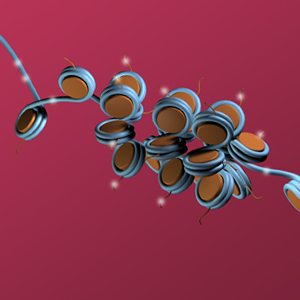
The bright marks on this epigenome represent the epigenetic marks. |
Twins and Their Role In The Field Of Epigenetics
Identical twins develop from a single zygote, which means they contain the same genome. Differences in genetics between the individuals are ruled out, leading to the changes on their gene soley based on enviormental factors. This research helps improve the research on epigenetics in humans because humans individually have too many differences already genetically. This video shows the simple way to understand how the epigenome in genetically similar twins can differ due to enviromental factors. |
This video (7) shows how identical twins, although genetically the same, can end up having different genes based on enviromental factors. |
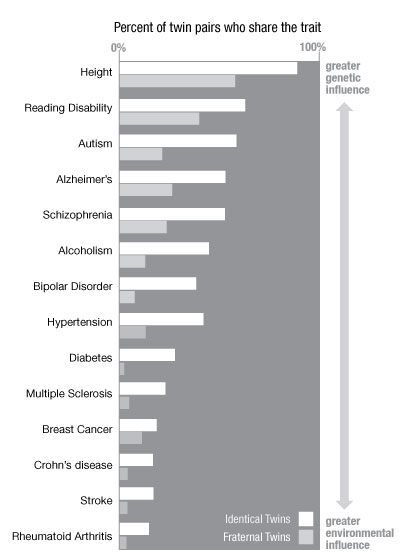
A higher percentage of disease incidence in both identical twins is the first indication of a genetic component. Percentages lower than 100% in identical twins indicates that DNA alone does not determine susceptibility to disease (7) |
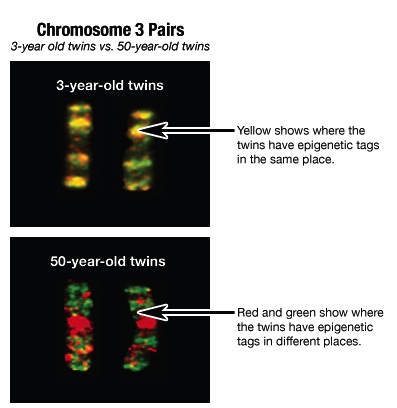
This picture shows the epigenetic tags' differences between twins at a young age and how they change when they age (7) |
|